Marrakech 2026: The Complete Guide to Morocco's Red City
11 October 2026 · 16 min read

Marrakech is one of the few cities where the old rule still holds: nothing within sight of the Koutoubia minaret is built taller than it, so the 12th-century tower keeps watch over a skyline of rose-pink walls and the snow-capped High Atlas behind them. That contrast — palm trees and 4,000-metre peaks in the same frame, often with snow on them between December and April — is the first thing that tells you Morocco's fourth-largest city is not the desert cliché you were sold. The walled medina is a UNESCO World Heritage Site, the souks still run on haggling rather than price tags, and in 2026 the monuments are more polished than they were five years ago: the Ben Youssef Madrasa reopened in April 2022 after a four-year restoration, and ticket prices across the royal sites were standardized in mid-2024. This guide is built on checked 2026 prices and hours, with a day-by-day plan, the exact taxi fares, and the specific stalls worth your dirhams.
🏙️ Essential Experiences
Marrakech's headline sights cluster in two zones: the historic medina (palaces, tombs, souks, the great square) and the newer Gueliz/Majorelle area a short taxi ride northwest. You can see the best of both in three days without rushing. Here are the eight that earn the entry fee.
Jemaa el-Fnaa
The medina's central square is a UNESCO "Masterpiece of the Oral and Intangible Heritage of Humanity," which is a grand way of saying it has been a stage for storytellers, musicians, and food hawkers for roughly 900 years and still is. By day it runs on orange-juice carts, henna artists, and snake charmers; after sunset it transforms into an open-air food court with numbered grill stalls, Gnaoua drum circles, and halqa (circle) performers. Entry is free, which is the catch — everyone on the square is working an angle.

Insider tip: Come at dusk, around 6pm, when the light is good and the stalls are firing up but the crowds haven't peaked. Watch a performance from the edge if you like, but a few dirhams in hand will be expected the moment you raise a camera — agree before you shoot, or don't shoot. Skip the chained Barbary apes and the snakes entirely; the animals are mistreated and the "free photo" ends in an aggressive demand for 100–200 MAD ($10–$20). A fresh orange juice from a cart is the honest pleasure here, usually 4–5 MAD a glass.
Koutoubia Mosque
The Koutoubia's 77-metre minaret, finished under the Almohads around 1199, is the template for Seville's Giralda and Rabat's Hassan Tower — same dynasty, same hands. Non-Muslims can't go inside the mosque, so the appeal is the exterior and the rose-garden esplanade on its southwest side, both free and open to anyone. It's a five-minute walk from Jemaa el-Fnaa and the clearest landmark for orienting yourself when the medina alleys scramble your sense of direction.

Insider tip: The gardens are at their best in late afternoon when the sandstone glows and the Atlas sometimes shows itself behind the tower. It's also the best free sunset spot in the city — bring nothing, buy nothing, just sit.
Bahia Palace
Bahia ("brilliance") is the most complete palace you can walk through in Marrakech, built in the late 19th century for Si Moussa and massively expanded by Grand Vizier Ba Ahmed between 1894 and 1900. The draw is the craft: hand-cut zellij tile, carved stucco, and painted cedar ceilings across a 150-room complex of courtyards and a harem wing. The grand marble courtyard, ringed by galleries painted in blue and ochre, is the photograph everyone comes for.

Entry 100 MAD ($10 / €9.50), daily 9am–5pm (last entry ~4:30pm). Insider tip: It opens at 9 and the tour buses arrive around 10:30, so be first through the gate for empty courtyards. There are almost no signs explaining the rooms; either hire a licensed guide at the entrance or read up before you go, because unguided you'll walk through beautiful empty rooms with no idea whose they were. It's a 10-minute walk from Jemaa el-Fnaa through the Mellah.
Ben Youssef Madrasa
This was the largest Quranic college in North Africa — rebuilt in the 1560s by the Saadian sultan Abdallah al-Ghalib, it once housed up to 900 students in 130 tiny cells around a central courtyard. It closed as a school in 1960, and after a four-year restoration it reopened in April 2022 looking better than it has in decades. The courtyard, with its reflecting pool, carved cedar, stucco, and a band of Quranic calligraphy running the walls, is the single finest piece of Islamic architecture open to visitors in the city.

Entry 50 MAD ($5 / €4.70), daily 9am–7pm. Insider tip: Climb to the upper floor and look into the student cells — they're the size of a single bed, which puts the "900 students" claim into perspective. Go in the first hour or the last; midday light flattens the courtyard and fills it with people. It sits deep in the souks near the Marrakech Museum, so string those together in one loop.
Saadian Tombs
The Saadian dynasty buried its sultans here in the late 16th century, then the following Alaouite ruler Moulay Ismail walled the whole necropolis up around 1700 rather than destroy it — bad luck to disturb the dead. It stayed sealed and forgotten until a French aerial survey rediscovered it in 1917. The showpiece is the Hall of Twelve Columns, where Sultan Ahmad al-Mansur lies under a vaulted cedar ceiling and muqarnas, surrounded by Italian Carrara marble columns and tombstones inlaid in zellij.
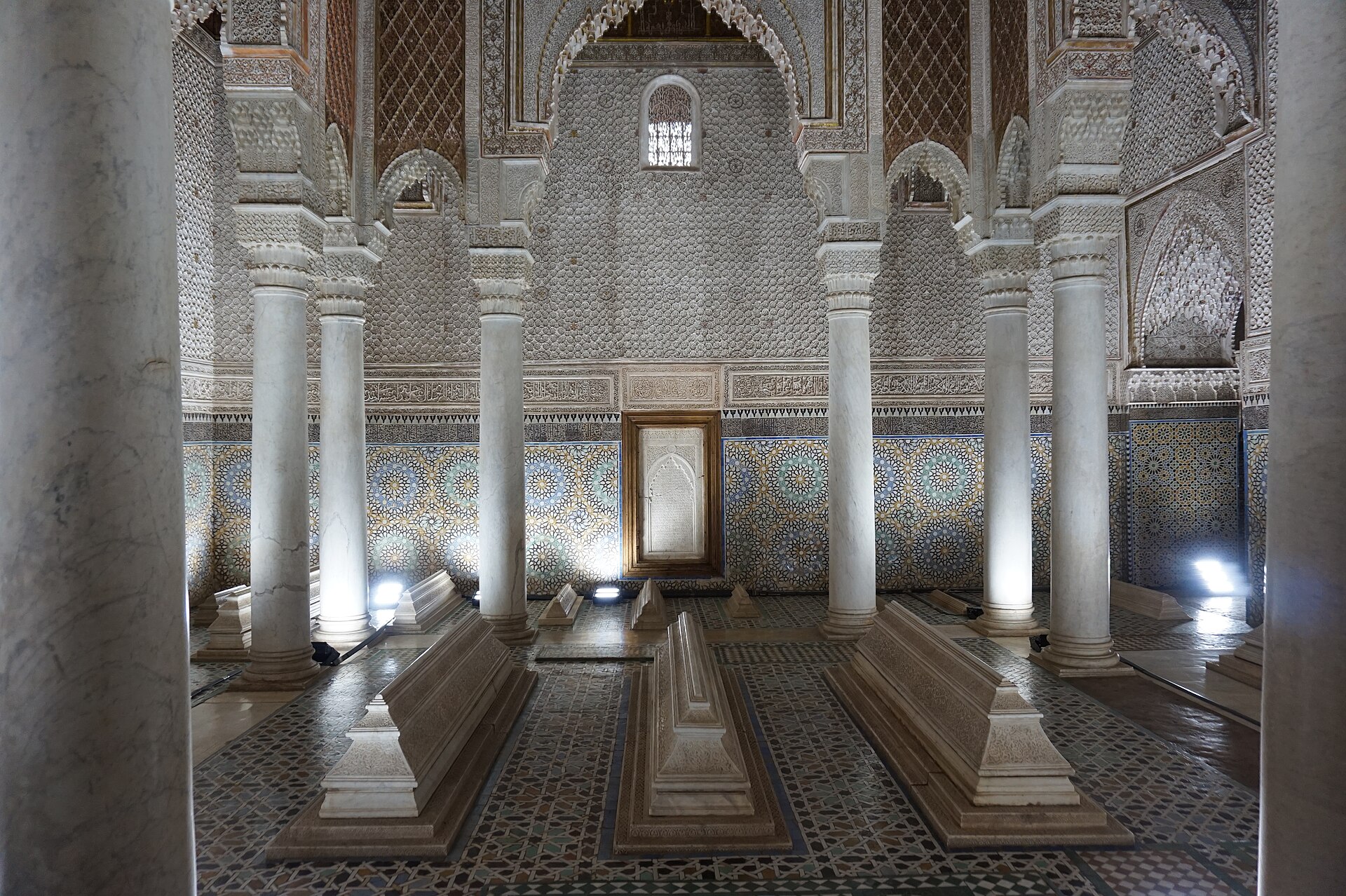
Entry 100 MAD ($10 / €9.50), open daily from 9am. Insider tip: The main chamber is viewed from a roped-off doorway, and a single line of visitors forms at it — arrive right at opening or you'll queue 20–30 minutes for a 30-second look. The site is small; 45 minutes covers it. It's beside the Kasbah Mosque, a 12-minute walk south of Jemaa el-Fnaa, and pairs naturally with El Badi next door.
El Badi Palace
Ahmad al-Mansur built El Badi ("the Incomparable") between 1578 and 1593 with ransom gold and Saharan trade wealth — 360 rooms, onyx, gold leaf, a sunken garden, and a central pool big enough to row on. Then Moulay Ismail spent a dozen years from the 1690s stripping it to the brick to build his new capital at Meknes. What's left is a vast, roofless ruin, which is its own kind of spectacle: raw pisé ramparts where storks now nest, sunken orange groves, and a rooftop terrace with the best wide view over the medina to the Atlas.

Entry 100 MAD ($10 / €9.50), daily 9am–5pm. Insider tip: Climb straight to the ramparts first for the panorama, then explore the sunken gardens — most people do it the other way and skip the view. The original 12th-century Koutoubia minbar (pulpit), a masterpiece of marquetry, is displayed in a side pavilion here; it's easy to miss and worth finding.
Jardin Majorelle & the YSL Museum
The French painter Jacques Majorelle spent forty years from 1923 building this garden and painting its villa in the electric cobalt now trademarked as "Majorelle Blue." Yves Saint Laurent and Pierre Bergé bought it in 1980, saved it from developers, and restored it; YSL's ashes were scattered in the rose garden here after his death in 2008. Inside are the Berber Museum (over 600 objects of Amazigh craft) and some 300 plant species. Next door, the Musée Yves Saint Laurent — a terracotta-brick building by Studio KO, opened in 2017 — holds a rotating selection of his haute couture.

Garden 170 MAD ($17 / €16); YSL Museum 135 MAD ($14 / €13), museum closed Wednesdays. The garden opens around 8am. Insider tip: This is the most oversubscribed site in Marrakech. Buy a timed ticket online in advance and take the very first entry slot — by 10am the narrow paths are a shuffling queue and the blue villa is impossible to photograph without forty strangers in it. It's in Gueliz, a 10-minute, ~40 MAD petit-taxi ride from the medina.
Le Jardin Secret
Hidden on Rue Mouassine in the thick of the souks, Le Jardin Secret is a restored Saadian-era riad complex that opened to the public in 2016. It has two gardens — a formal Islamic char bagh and a looser Exotic Garden — both still watered by the original khettara, an underground hydraulic system that channels water from the Atlas foothills. A roughly 17-metre tower gives you a rooftop view back over the medina rooftops to the Koutoubia and the mountains.

Entry 100 MAD ($10 / €9.50); tower an extra 40 MAD ($4). Open 9:30am–6:30pm March–September, to 6pm the rest of the year. Insider tip: It's a genuinely calm spot to decompress mid-souk, with a café in the courtyard. Pay for the tower — the view is the reason to come, and the climb is short. Last admission is 30 minutes before closing.
🗓️ A 3-Day Itinerary
This plan keeps the medina sights together on foot and saves the taxi-ride-out attractions for one block, so you're not crisscrossing the city. Budget roughly 400–550 MAD ($40–55) per person per day for entries, taxis, and food, not counting your room.
Day 1 — The Medina Core
Start at the Bahia Palace at 9am sharp (100 MAD), before the buses. Walk 10 minutes south to the Saadian Tombs (100 MAD) and the adjacent El Badi Palace (100 MAD) — the two are a five-minute walk apart in the Kasbah. Break for lunch at a rooftop near Rahba Kedima: Café des Épices does a solid salad-and-tagine spread for around 100–150 MAD. In the afternoon, get lost in the souks on purpose — the dyers' and metalworkers' lanes north of the square — and aim to be on Jemaa el-Fnaa by 6pm for sunset and dinner at the night stalls (a full plate of grills, bread, and salad runs 50–90 MAD). Total walking: about 3–4 km over the day.
Day 2 — Gardens & Gueliz
Taxi to Jardin Majorelle for the 8am opening (170 MAD garden; pre-book), then the YSL Museum next door (135 MAD) if it's not a Wednesday. The ride from the medina is about 10 minutes and ~40 MAD by meter. Spend late morning in Gueliz, the modern quarter — coffee on a café terrace, lunch at Al Fassia, a long-running women-run restaurant known for its pastilla and lamb tagine (mains ~120–180 MAD). Taxi back to the medina for the afternoon and visit the Ben Youssef Madrasa (50 MAD) in the quieter late-afternoon light, then Le Jardin Secret (100 MAD + 40 MAD tower) to close the day with a rooftop view.
Day 3 — Slow Morning, Then the Walls or the Atlas
Use the morning for what you skipped: the Koutoubia gardens and a slow coffee, a hammam, or a shopping loop through the souks now that you know the lanes. If you have a half-day, take a booked car out to the Sidi Ghanem design district (see below), or swap a day of monuments for a trip to the Ourika Valley in the Atlas foothills, about 60–90 minutes out by car.
🧠 Essential Tips
When to go
Target March–May and October–November. Spring and autumn sit in the low-to-mid 20s°C by day with comfortable evenings, which is exactly what you want for a city you explore on foot. Summer is brutal — July and August average highs around 37°C (98°F) and the record is near 49°C — and the medina's walls trap the heat well past dark. Winter days are mild (13–18°C) and good for sightseeing, but nights drop toward 6°C and many riads heat rooms poorly, so pack a layer. Note that during Ramadan, many monuments shorten their hours and daytime food options in the medina thin out.
Getting in from the airport
Marrakech Menara Airport (RAK) is only about 4–6 km from the medina. The cheapest option is the ALSA Bus 19 from outside arrivals: 30 MAD one-way, or 50 MAD return (the return is valid about two weeks), running roughly every 20–30 minutes from around 6am to 11:30pm, terminating near Jemaa el-Fnaa. A grand taxi from the rank is unmetered — agree the fare before you get in; the going rate is about 100 MAD to the medina or Gueliz in the day, and closer to 150 MAD after 8pm with the night supplement. Drivers will quote more; the posted tariff board at the rank is your reference point.
Getting around
Inside the walls, Marrakech is a walking city — most of the medina is too narrow for cars, so expect to cover the last 5–15 minutes to your riad on foot with your bag. For longer hops, flag a petit taxi (beige, maximum three passengers) and insist on the meter; a medina-to-Gueliz ride is 20–40 MAD metered, though drivers often try a 50–70 MAD flat rate on tourists. Heetch is the ride-hailing app locals actually use here (Uber pulled out of Morocco years ago), and it removes the fare argument entirely. Download it before you arrive and link a card.
Scams and safety
Marrakech is broadly safe for visitors — the risks are hassle and overcharging, not violence. The classics: someone insisting your route is "closed" or the tannery is "only open today" to steer you to a shop for a commission; henna women who grab your hand and start painting before naming a price; and the animal-photo setup on Jemaa el-Fnaa that ends in a 100–200 MAD demand. The fix is the same for all of them: a firm "la, shukran" (no, thank you), keep your hands to yourself, and keep walking. Don't follow anyone who "helpfully" offers to lead you somewhere — use the map on your phone. Official guides carry a badge; unsolicited "guides" don't. There's a police post at the edge of Jemaa el-Fnaa if a situation escalates.
Food worth seeking out
The dish that belongs to Marrakech is tangia (tanjia marrakchia) — lamb or beef sealed in a clay urn with preserved lemon, garlic, and cumin and left to cook for hours in the ashes of a hammam furnace. It's a workingman's slow-food specialty you won't find done the same way elsewhere in Morocco. For mechoui (slow-roasted lamb), head to Mechoui Alley off the north end of Jemaa el-Fnaa around 11am–2pm, where it's sold by weight — roughly 260 MAD per kilo, and half a kilo feeds two. Many stalls close Fridays. On the square at night, the numbered food stalls serve harira (chickpea-lentil soup), grilled merguez, and for the brave, babbouche (snail soup) and sheep's head. Order from the posted menu, confirm quantities and price up front, and sit where locals are eating; a handful of stalls are notorious for padding the bill. For a sit-down meal, Nomad near Rahba Kedima does modern Moroccan with a rooftop, and Al Fassia in Gueliz is the standard-bearer for classic home-style cooking.
🏨 Accommodation Guide
Where you sleep shapes the whole trip here more than in most cities, because the medina and the new town are genuinely different worlds.
Budget (roughly 400–700 MAD / $40–70 per night): Stay in a medina guesthouse or a simple riad. The Mouassine and Bab Doukkala areas in the northern medina are quieter than the blocks right on Jemaa el-Fnaa, which stay loud until the early hours. You'll trade a bit of polish for location — a bed, a plunge pool, a rooftop breakfast, and everything within walking distance.
Mid-range (roughly 800–1,500 MAD / $80–150): This is the sweet spot for a restored riad — a traditional courtyard house with a handful of rooms, a central fountain, and a roof terrace. The medina is full of them. If you want lifts, parking, reliable air conditioning, and a quieter night, book instead in Gueliz, the modern quarter, where a comfortable double runs in this range and the restaurants and cafés are a short walk rather than a taxi away.
Luxury (3,000–5,000+ MAD / $300–500+): Design-led boutique riads cluster in the medina — Riad El Fenn near Bab el Ksour is a long-standing favorite — while the Kasbah holds landmark properties like La Sultana. For full resort treatment, the Royal Mansour (built by the King, with private riads) and the hotels of Hivernage deliver spas and space near the center. Palmeraie, 6–10 km out among the palm groves, is where the pool-and-garden resorts sit — lovely for unwinding, less so if you want to walk to the souks, since every trip in is a 60–120 MAD taxi.
🎭 Beyond the Tourist Trail
When the monuments start to blur, Marrakech has a creative life well outside the postcard loop. Sidi Ghanem, a former industrial zone about 15–20 minutes north of the center, has become the city's design district — a grid of warehouses turned into ateliers and concept stores. It's where you find the makers behind the goods you see marked up in the souks: Marrakshi Life for hand-woven slow fashion, Topolina for reworked vintage pieces, ceramics studios, lighting workshops, and Jajjah, a café-gallery tied to the artist Hassan Hajjaj with a lunch menu cooked by local women. It's spread out and laid out in a grid, so hire a driver for the half-day and treat it as a shopping-and-lunch expedition rather than a stroll.
Back in the medina, the Mellah — the old Jewish quarter southeast of Bahia Palace — is worth an hour for its spice and herb market and the restored Lazama (Al-Azama) Synagogue, a reminder that Marrakech's history isn't only the one on the souk postcards. And if your dates are flexible, the Marrakech International Film Festival brings red carpets, open-air screenings on Jemaa el-Fnaa, and a jolt of glamour to the city; the 23rd edition runs 20–28 November 2026.
❤️ Let VoyaBear Plan Your Marrakech Trip
Marrakech rewards a plan: the right entry times beat the crowds, the right neighborhood decides whether you sleep or lie awake, and the right taxi fare saves you an argument a day. VoyaBear builds all of that into a personalized itinerary — timed tickets, a medina route that doesn't double back, riad picks matched to your budget and your tolerance for noise, and the day trips worth taking into the Atlas. Tell us your dates and your pace, and we'll hand you a Marrakech trip that runs as smoothly as this guide reads. Start planning with VoyaBear today.
Want this as an actual itinerary?
VoyaBear turns a guide like this into a day-by-day plan built around how you travel.
Plan my trip free