Ubud 2026: The Complete Guide to Bali's Cultural Heart
5 November 2026 · 18 min read

Ubud is the Bali that existed before the beach clubs: a town of 30-odd villages stitched together by rice terraces, where offerings of flowers and rice sit on every doorstep and a gamelan orchestra is usually warming up somewhere out of sight. It sits about 40 km inland in the Gianyar hills, and in 2026 it is busier and pricier than the Ubud of Eat, Pray, Love — the Monkey Forest now charges IDR 130,000 and the central lanes clog with scooters by mid-morning. But get up before the crowds, point yourself at a rice field or a water temple, and the reason people keep coming is still obvious. This guide is built on 2026 prices and real place names so you can skip the guesswork.
💡 Quick Answer: Ubud at a Glance
The essentials for planning an Ubud trip, with 2026 prices.
- How many days? 3 days — one for central Ubud on foot, one for countryside temples, one for wellness or villages.
- Best time to visit: June-September (dry, green); April, May and October are quieter and still dry.
- Book ahead: a Legong or Kecak dance ticket (IDR 100,000 / ~USD 6) and a full-day driver for the temple loop (~IDR 650,000 / ~USD 40).
- Airport to Ubud: ~40 km, 1.5-2.5 hrs; private transfer from IDR 325,000 (~USD 20) or a Grab/Gojek car ~IDR 350,000-400,000.
- Getting around: walk the centre; use Grab/Gojek apps (car rides IDR 40,000-70,000) or rent a scooter (IDR 100,000-150,000/day).
- Daily budget: roughly USD 35-55 backpacking, USD 90-180 mid-range, USD 350+ for a jungle resort.
- Must-pay tax: the one-time Bali tourist levy, IDR 150,000 (~USD 10), paid online via Love Bali before arrival.
- Top safety note: the Monkey Forest macaques steal sunglasses, phones and water bottles — carry nothing loose.
🏛️ The Best Things to Do in Ubud
Sacred Monkey Forest Sanctuary
This 12.5-hectare nutmeg forest in the middle of town is a genuine Hindu temple complex — three moss-covered temples, a ravine, a dragon bridge — that happens to house around 1,200 long-tailed macaques. It is worth it for the setting as much as the monkeys; the banyan roots and stone guardians feel cinematic in morning light. Insider tip: arrive right at the 09:00 opening to walk the lower temple loop before tour groups and before the midday heat makes the monkeys cranky. Empty your pockets, take off dangling earrings and sunglasses, and never hold food — these are wild animals that have learned tourists carry snacks. Cost: IDR 130,000 adults / IDR 100,000 children (from April 2026), open daily 09:00-18:00.

Tegallalang Rice Terrace
The most photographed rice terraces on Bali, carved into a steep valley 20 minutes north of Ubud and irrigated by the centuries-old subak cooperative water system that UNESCO recognises as cultural heritage. You can walk down one side of the valley and up the other in about 45 minutes. Insider tip: come before 08:30 — by mid-morning the terraces fill up and small 'donation' gates (IDR 10,000-20,000) appear along the paths. Wear real shoes; the steps are mud when wet. The famous jungle swings here cost IDR 150,000-500,000 and are pure Instagram theatre — skip them unless that's your thing. Cost: IDR 25,000 entry.

Tirta Empul Temple
A 10th-century water temple built around a sacred spring, where Balinese Hindus queue to bathe under a row of carved stone spouts in a purification ritual called melukat. Visitors can take part respectfully: you'll be given a sarong and, if you bathe, a change of clothes is essential. Even if you just watch, the courtyards and the bubbling spring pool are extraordinary. Insider tip: go early and enter the bathing pool from the far-left spout, working rightward as locals do; skip the final two spouts, which are reserved for funeral rites. Cost: IDR 75,000 adults (sarong included).

Campuhan Ridge Walk
A free, flat, paved path along a grassy spine between two river valleys — the easiest and prettiest walk in Ubud, about 2 km each way starting near the Gunung Lebah temple at the west edge of town. Insider tip: do it at sunrise (around 06:00) or in the last hour before sunset; by 09:00 there's no shade and the ridge bakes. The far end opens onto Karsa Kafe and a cluster of warungs where you can refuel before walking back. Bring water; there's nothing to buy until the end. Cost: free.

Saraswati Temple (Pura Taman Saraswati)
A small but ravishing temple a minute's walk off the main road, fronted by a long lotus pond and an ornately carved paras-stone gate dedicated to Saraswati, the goddess of knowledge and the arts. You enter along a causeway between the lotus flowers. Insider tip: entry to the garden is free, and the real move is to order a drink at the adjoining Cafe Lotus and stay for the evening Legong or Kecak dance performed against the lit-up temple several nights a week. The lotus blooms open in the morning. Cost: free to visit the garden.

Goa Gajah (Elephant Cave)
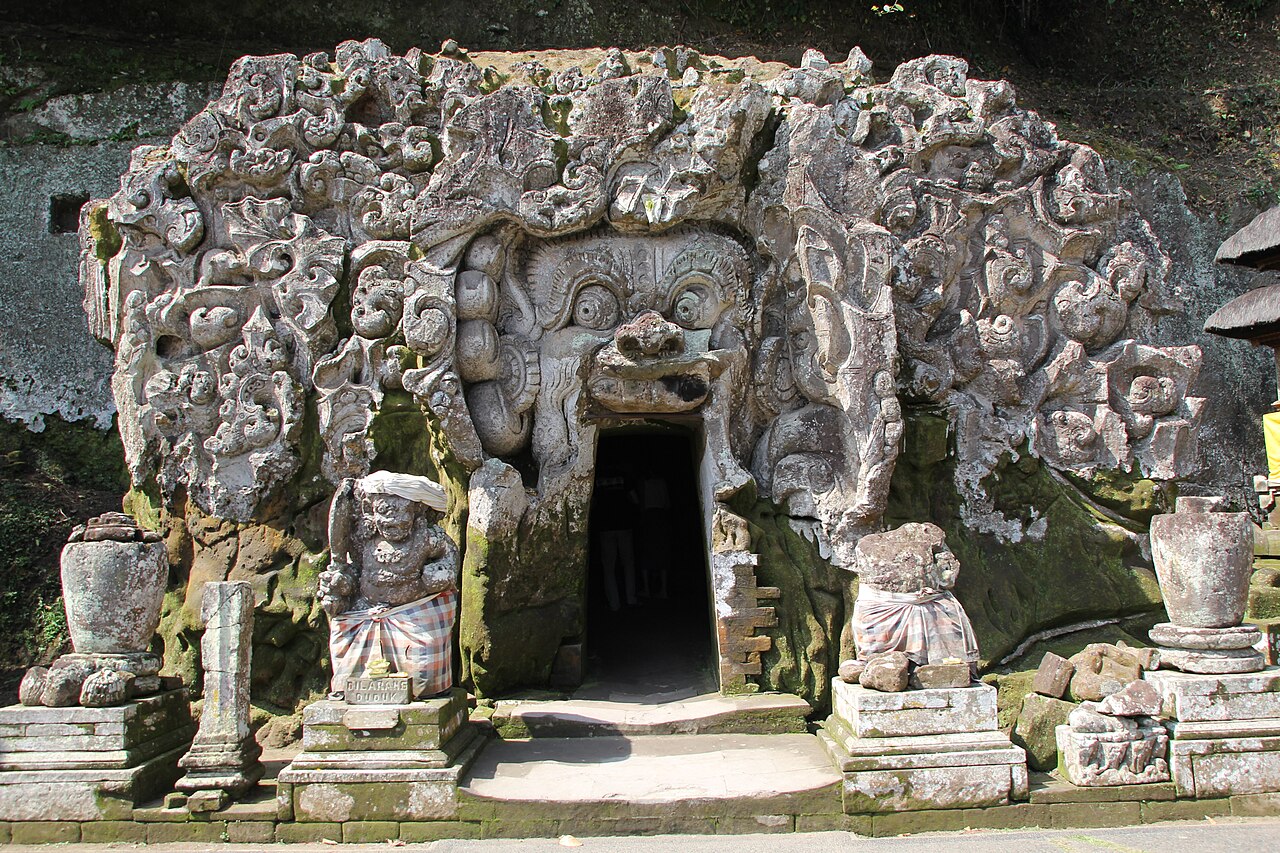
A centuries-old rock-cut sanctuary just southeast of Ubud, named for the demonic face carved around its cave mouth — you step through the gaping stone mouth into a cross-shaped meditation cave. Below sit a set of ancient bathing pools with spouting water-nymph statues, excavated only in the 1950s. Insider tip: it's small, so pair it with the temple loop rather than a special trip; go in the morning before the tour coaches, and bring or hire a sarong (included in the ticket). The garden ravine behind the cave, with its mossy fragments and stream, is the best and least-visited part. Cost: IDR 50,000 adults.
Ubud Palace & Art Market
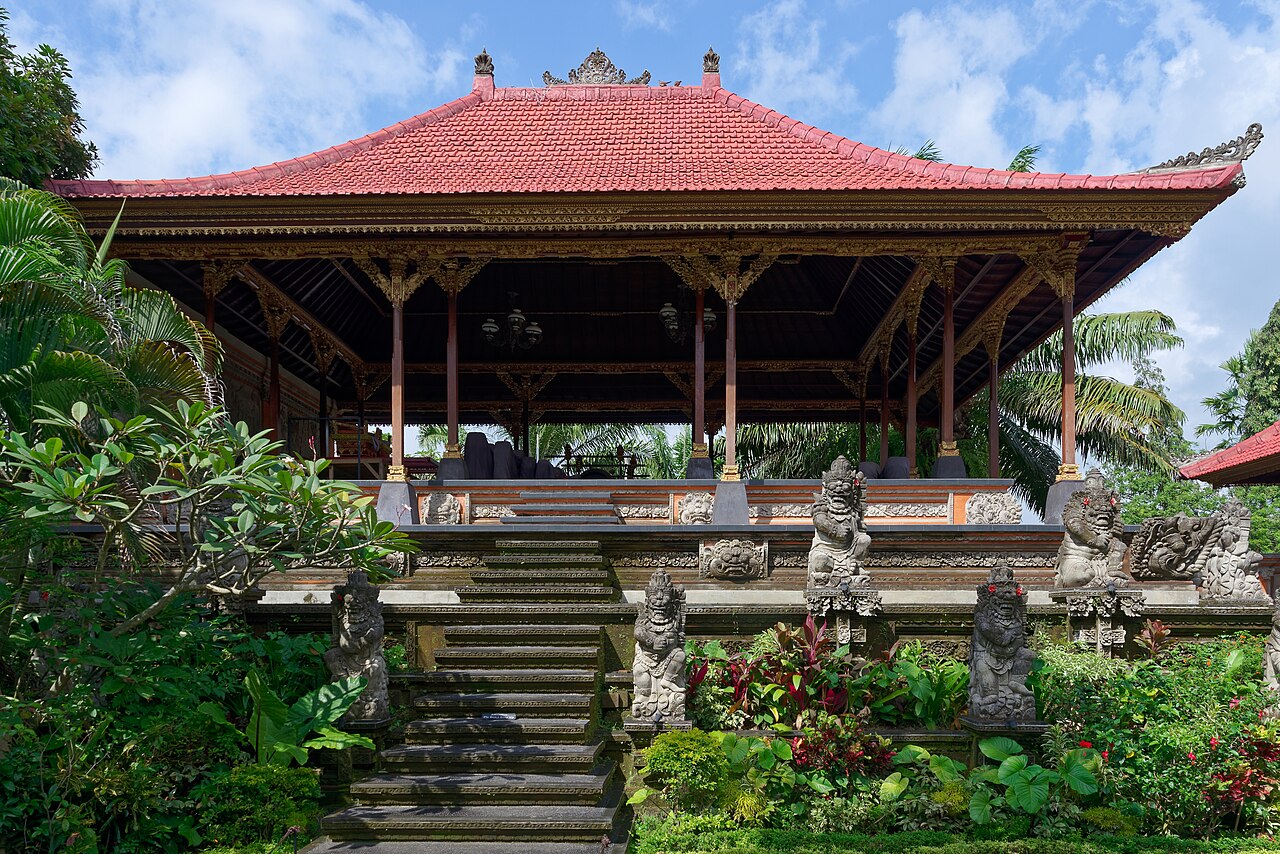
Puri Saren Agung, the royal palace of Ubud's ruling family, still anchors the main crossroads — a compound of ornate pavilions and split gates that you can wander for free during the day and that transforms into a dance stage at night. Directly across the road, the two-storey Ubud Art Market (Pasar Seni) sells sarongs, rattan bags, wood carvings and silver. Insider tip: the palace is free; come at 19:30 for the nightly Legong dance (IDR 100,000). At the market, the upstairs stalls are cheaper and quieter, and the opening price is typically three to four times what vendors will accept — haggle with a smile. Cost: palace free; dance IDR 100,000.
Tegenungan Waterfall
One of the few big waterfalls on low-lying south Bali, a wide curtain of water crashing into a jungle gorge about 30 minutes south of central Ubud. It's a steep flight of steps down (and a sweaty climb back up) to a plunge pool you can swim in. Insider tip: arrive before 09:00 or after 16:00 to avoid both the crowds and the harshest sun; the viewpoint cafes up top are a fine place to see it if you don't fancy the stairs. The current at the base is strong after rain — wade, don't swim out. Cost: IDR 30,000.

🗓️ How to Spend Three Days in Ubud
Day 1 — Central Ubud on foot
Start at Ubud Palace and the Saraswati Temple lotus pond before the heat, then browse the Ubud Art Market across the road. Walk 10 minutes down Jalan Monkey Forest for an early lunch of babi guling at Ibu Oka (around IDR 55,000), then spend the early afternoon in the Sacred Monkey Forest (IDR 130,000) at the quieter south end of that same street. Taxi or walk to the west side of town for the Campuhan Ridge Walk around 16:30 as it cools. Finish with the 19:30 Legong dance back at the Palace (IDR 100,000). Total walking: 4-5 km. Day cost excluding meals: roughly IDR 230,000 (~USD 14).
Day 2 — Temples and terraces by driver
Hire a private driver for the day (IDR 600,000-700,000, about USD 40 for 8-10 hours) — it's the sane way to link the sights outside town. Leave by 08:00 for Tegallalang Rice Terrace (IDR 25,000) before the buses, then north to Tirta Empul (IDR 75,000) for the purification pools. Loop back via Goa Gajah (IDR 50,000) and, if there's time and light, Tegenungan Waterfall (IDR 30,000). Have the driver drop you for dinner at Bebek Bengil (the Dirty Duck) for crispy duck. Entry fees total about IDR 180,000 (~USD 11) plus the driver.
Day 3 — Slow Ubud, villages and wellness
Start with a sunrise lap of the Campuhan ridge or a morning yoga class at The Yoga Barn on Jalan Raya Pengosekan (drop-in around IDR 150,000). Walk up the stone stairs into Penestanan, the painters' village, for rice-field cafes and galleries, then take a half-day Balinese cooking class (IDR 350,000-500,000, usually with a market visit). Refuel with single-origin coffee at Seniman Coffee Studio. If it's a Wednesday or Saturday, end with the Kecak fire and trance dance at Pura Dalem Taman Kaja at 19:00 (IDR 100,000) — the a cappella chant of 60-plus men is the one performance not to miss.
✅ Essential Tips for Visiting Ubud
When is the best time to visit Ubud?
The dry season, April to October, is the reliable choice, and June to September is the pick of it: daytime highs of 27-30C, cooler 20-22C evenings, and brief, rare showers. April, May and October are nearly as dry with thinner crowds and softer prices. The rainy season (November to March) brings humid days and heavy but short afternoon downpours — the countryside is at its greenest and hotels are cheapest, but plan sights for the mornings. One hard rule: if your trip touches Nyepi (the Balinese Day of Silence, in March), the entire island — including the airport — closes for 24 hours and you are expected to stay indoors.
How do you get around Ubud?
Central Ubud is walkable, if you accept narrow pavements and no gutters. For anything further, the ride-hailing apps Grab and Gojek are cheapest and have fixed prices — scooter rides in town run IDR 15,000-30,000 and cars IDR 40,000-70,000. Note that some central zones are 'no-go' areas for app drivers due to local taxi associations, so you may be asked to walk a block to the pickup point. To explore independently, rent a scooter (IDR 100,000-150,000 per day) — but only if you can actually ride one and have the right licence, as the hilly, potholed roads are unforgiving. For the out-of-town temple circuit, a private driver-guide at around IDR 650,000 for the day is the most efficient option.
Is Ubud safe for tourists?
Very — violent crime against tourists is rare, and the risks are mostly mundane. The Monkey Forest macaques are the number-one hassle: they will snatch sunglasses, phones, loose bags and anything that looks like food, so secure your belongings before you enter. Scooter accidents are the real danger in Bali; if you ride, wear the helmet and don't attempt the mountain roads as a first-timer. Watch the pavements, which flood and buckle. On money, avoid the 'metered' street taxis that won't use the meter — stick to the apps or agree a flat fare first — and change money only at authorised counters (the ones advertising suspiciously good rates are the classic short-change scam). Tap water is not drinkable; stick to sealed or filtered water.
What should you eat in Ubud?
Ubud eats well across every budget. The signature dish is babi guling, spit-roasted suckling pig with crackling and spiced rice — the institution is Warung Babi Guling Ibu Oka near the Palace. Try bebek betutu (slow-cooked smoked duck) and the famous crispy bebek goreng at Bebek Bengil, pork ribs and cold Bintangs at Naughty Nuri's in Sanggingan, and a cheap, excellent plate of nasi campur (rice with a spread of small dishes) from the Ubud morning market on Jalan Raya Ubud before the souvenir stalls take over. Ubud is also Bali's vegetarian and health-food capital — smoothie bowls and plant-based cafes are everywhere — and the coffee at Seniman Coffee Studio is the serious cup in town.
🏨 Where to Stay in Ubud
Budget (USD 10-35/night): Ubud is full of family-run homestays — a room in a traditional compound with breakfast, often for under USD 25. Cluster around Jalan Goutama and Jalan Karna in the centre for walkability, or look at social hostels like In Da Lodge for dorms. Staying with a family is the classic, inexpensive Ubud experience.
Mid-range (USD 60-180/night): This is where Ubud shines — stylish boutique hotels with pools and rice-field or valley views. Look in Penestanan and Sanggingan (walkable to town but quieter) or central names like Alaya Resort Ubud. Expect an infinity pool, a spa and serious breakfast for the price of a mediocre chain hotel back home.
Luxury (USD 300-1,200+/night): The jungle resorts of the Ayung River valley around Sayan and Payangan are destinations in themselves — Four Seasons Resort Bali at Sayan, Mandapa (a Ritz-Carlton Reserve) and COMO Uma Ubud among them, with valley-edge infinity pools and private villas. If you only splurge once in Bali, do it here rather than by the beach.
🎭 Beyond the Tourist Trail
Most day-trippers never leave the Palace-to-Monkey-Forest corridor, which means the rest of Ubud is quieter than it looks. Walk the stone stairs up into Penestanan, the expat-and-artist village on the ridge west of the centre, for rice-paddy cafes and painting studios a world away from the market crush. South of the Monkey Forest, the village of Nyuh Kuning is a sleepy grid of woodcarvers' workshops and warungs where you can eat a proper nasi campur for a third of the main-street price. For a half-day escape, have a driver take you east to the Sidemen valley, which looks like Ubud did 30 years ago — terraces, almost no tour buses, and Mount Agung on the horizon.
Time your visit to the Ubud Writers & Readers Festival, held every October since 2004, and the town fills with authors, panels and long-table dinners — Southeast Asia's flagship literary event, and proof that Ubud's reputation as Bali's thinking, creative heart is more than marketing.
❓ Ubud FAQ
How many days do you need in Ubud?
Three days is the sweet spot: one for central Ubud on foot (Palace, Monkey Forest, Campuhan Ridge Walk), one for the countryside temples and rice terraces with a hired driver, and a third for wellness, villages, or a cooking class. Two days covers the highlights if you are tight; a week lets Ubud slow you down, which is the whole point.
What is the best time to visit Ubud?
June to September is the best window: dry, 27-30C days, and lush green rice fields. April, May and October are also reliably dry with thinner crowds. The rainy season runs November to March with short heavy afternoon downpours. Avoid Nyepi (the Balinese Day of Silence, in March), when the whole island shuts down for 24 hours and the airport closes.
How much is the Monkey Forest entrance fee in 2026?
From 1 April 2026, the Sacred Monkey Forest Sanctuary charges foreign adults IDR 130,000 (about USD 8) and children aged 3-12 IDR 100,000. It opens daily 09:00-18:00, with the ticket counter closing at 17:00.
How do you get from the airport to Ubud?
Ngurah Rai (Denpasar) airport is about 40 km south of Ubud, a 1.5-2.5 hour drive depending on traffic. A pre-booked private transfer runs from around IDR 325,000 (USD 20); a Grab or Gojek car is roughly IDR 350,000-400,000. Both ride apps have staffed pickup lounges at the airport.
Is Ubud safe for tourists?
Ubud is very safe for a tourist town. The real hazards are practical: aggressive long-tailed macaques in the Monkey Forest (carry nothing loose and don't feed them), chaotic scooter traffic on narrow roads, and slick, uneven pavements. Watch for inflated 'fixed-price' taxi fares and always agree a price or use the app meter before you ride.
What should you eat in Ubud?
Start with babi guling (Balinese roast suckling pig) at Warung Babi Guling Ibu Oka near the Palace, then crispy bebek betutu (smoked duck) at Bebek Bengil, pork ribs at Naughty Nuri's in Sanggingan, and a plate of nasi campur from the Ubud morning market. Finish with single-origin Indonesian coffee at Seniman Coffee Studio.
Do you need to pay the Bali tourist tax?
Yes. Every foreign visitor pays a one-time Bali tourist levy of IDR 150,000 (about USD 10) per trip, separate from any visa fee. Pay it online before you arrive through the official Love Bali portal or app and keep the QR-code voucher on your phone.
Where should you stay in Ubud?
For nightlife and walkability, stay central around Jalan Monkey Forest or Jalan Hanoman. For quiet rice-field views, pick Penestanan, Sanggingan or Nyuh Kuning, a short walk or ride from the centre. For splurge jungle resorts, head to the Ayung River valley around Sayan and Payangan.
❤️ Let VoyaBear Plan Your Ubud Trip
Ubud rewards a plan: the temples that need an early start, the one free walk worth waking up for, the night the Kecak actually runs. VoyaBear builds that plan around you — your dates, your pace, your budget — stitching the right rice-terrace morning, temple loop and jungle resort into an itinerary with real times, real costs and real bookings. Tell VoyaBear what you love, and get a personalised Ubud trip in minutes. Your Bali, minus the guesswork.
Want this as an actual itinerary?
VoyaBear turns a guide like this into a day-by-day plan built around how you travel.
Plan my trip free