Bilbao 2026: The Complete Guide to Basque Spain
22 October 2026 · 22 min read

Bilbao spent a century as a gritty iron-and-shipbuilding town, and then in October 1997 Frank Gehry's titanium Guggenheim landed on the riverbank and rewrote the city's entire reputation. The "Bilbao effect" became shorthand in architecture schools for one building dragging a whole city into the future. Nearly thirty years on, that story got a 2026 sequel: on 6 October the Museo de Bellas Artes reopened after a near-four-year, roughly 6,000-square-metre expansion by Norman Foster, giving Bilbao a second world-class art museum two riverside blocks from its first. So this is a good year to come. Add Basque food that routinely outpunches cities ten times the size, a metro designed by Foster, and a walkable centre you can cross in twenty minutes, and you have one of Spain's most rewarding short-break cities — rain and all.
This is a compact city that rewards a slow pace: pintxos instead of sit-down dinners, a funicular instead of a tour bus, and a river you follow on foot from a UNESCO-listed Victorian bridge to a curved Calatrava footbridge. Here's exactly how to do Bilbao in 2026, with real prices, real bar names, and the timings that keep you out of the queues.
💡 Quick Answer: Bilbao at a Glance
The essentials for planning a Bilbao trip, with 2026 prices (roughly $1.08 to the euro):
- How many days do you need? Three days covers the city properly — two for Bilbao itself, one for a day trip to the coast or San Sebastián.
- Best time to visit? Late May–June and September: mild (20–24°C), drier, and cheaper than peak August.
- What to book ahead? Guggenheim tickets online (€12 / ~$13, adult) to skip the queue; a table at Nerua or Mina if you want Michelin; the Vizcaya Bridge walkway only if heights appeal.
- Airport to centre? Bizkaibus A3247 to Plaza Moyúa, €1.50 with a Barik card or €4.50 cash, every 15–30 minutes, about 25 minutes. A taxi is €20–30.
- Getting around? The Barik card (€3 + a €5 minimum top-up) works on the metro, tram, Bizkaibus and the Artxanda funicular, cutting every fare.
- Daily budget? Around €70 (~$76) backpacking, €150 (~$162) mid-range, €250+ (~$270) comfortable, excluding your hotel's swing between seasons.
- Signature food? Pintxos (not "tapas"), bacalao al pil-pil, and txakoli — the slightly fizzy Basque white poured from a height.
- Top safety note? Bilbao is very safe; the only real risk is pickpocketing in the crowded Casco Viejo bars and on the metro, worse during the August fiestas.
🎭 The Best Things to Do in Bilbao
1. The Guggenheim Museum — the building that changed the city
Gehry's museum is still the reason most people book a flight, and it earns it. The 33,000 titanium panels shift colour with the weather, so a grey Bilbao sky actually works in its favour. Outside and free to see: Jeff Koons' 12-metre flower-covered Puppy guarding the entrance, Louise Bourgeois' giant bronze spider Maman on the river terrace, and Anish Kapoor's mirror-ball Tall Tree & the Eye. Inside, don't rush Richard Serra's The Matter of Time — a hall of weathered-steel spirals you walk through, not past. General admission is €12 (~$13) for adults, €6 for students and over-65s, and free for under-18s; a combined ticket with the Fine Arts Museum is €16 (~$17).

Insider tip: buy online from the museum's own site (it openly warns about resale fraud) and aim for the 10am opening on a weekday — the tour groups hit around noon. It's open Tuesday to Sunday, 10am–7pm, and closed most Mondays, so don't plan your one museum day for a Monday.
2. Casco Viejo and the Siete Calles — where Bilbao actually eats
The old town, built around the original Siete Calles (Seven Streets, or Zazpi Kaleak), is where you do your eating and your aimless wandering. The arcaded neoclassical Plaza Nueva is the pintxo epicentre: grab a jugosa (deliberately runny) tortilla slice at Café Bar Bilbao for €2.50, then the low-temperature egg with truffle at Gure Toki (Plaza Nueva 12, pintxos €2.50–4.50). Work the side streets — Calle Jardines, Calle del Perro — for Sorginzulo's croquetas and the flambéed prawn skewer at Irrintzi on Calle Santa María. On Sunday mornings the square fills with a flea and stamp market.

Insider tip: this is poteo, not a sit-down dinner — order one pintxo and one small drink (a zurito of beer or a txikito of wine) per bar, eat standing, then move on. Pay as you go at each counter. Don't stack a plate; it marks you instantly as a tourist and the good stuff is made to order anyway.
3. Mercado de la Ribera — the riverside food cathedral
Two minutes from Plaza Nueva, on the right bank of the river, the Mercado de la Ribera is a 10,000-square-metre covered market from 1929, designed by Pedro Ispizua, that the Guinness Book of Records once logged as the most complete municipal food market in the world. The ground floor is a working market — fish, Idiazabal cheese, piquillo peppers — while the upper level has turned into a row of modern gastro-bars where you can eat a Gilda (the olive-anchovy-guindilla skewer named after the Rita Hayworth film) for €2–4 and a glass of txakoli alongside.
Insider tip: come late morning to watch it actually function as a market, or around 1pm to eat upstairs before the lunch crush. It closes Sunday, so slot it into a weekday. It's free to walk through — you only pay for what you eat.
4. Mount Artxanda and its funicular — the city from above
For the view that puts the whole city in context, take the Artxanda funicular up the hill behind the Guggenheim. The cable car climbs roughly 770 metres in about three minutes, running every 10–15 minutes from 7:15am (8:15am Sundays and holidays) until 10pm, later on summer weekends. A paper ticket is €3.50 one way or €6 return, and noticeably cheaper on a Barik card. At the top: a viewpoint over the titanium museum, the serpentine river, San Mamés stadium, and the green hills closing in on all sides.

Insider tip: go up an hour before sunset. Bilbao faces into its hills, so the evening light rakes across the city and the Guggenheim lights up. There are two txakoli restaurants near the top station if you want to make an evening of it rather than ride straight back down.
5. The Zubizuri and the riverfront bridges
The Nervión is Bilbao's spine, and the three-kilometre Abandoibarra promenade from the old town to San Mamés is the city's best free walk. Its centrepiece is the Zubizuri ("white bridge" in Basque), Santiago Calatrava's 1997 arched footbridge with a glass deck — gorgeous, and famously slippery in the rain until the city quietly added grip. Just upstream, the La Salve bridge wears a vivid red arch, Daniel Buren's Arcos Rojos, framing the Guggenheim; behind the Zubizuri rise the two leaning towers of Isozaki Atea by Arata Isozaki.

Insider tip: walk this west-to-east in the late afternoon, ending at the Guggenheim for golden hour and Nakaya's fog sculpture, which the museum releases around the building at set times. It costs nothing and it's the single best way to understand how the regenerated city fits together.
6. The Vizcaya Bridge — the world's first transporter bridge
Fifteen minutes downriver by metro, the Vizcaya Bridge (Puente Colgante) is Bilbao's quieter UNESCO headline act. Built in 1893 by Alberto Palacio, it was the world's first transporter bridge: instead of a fixed deck, a gondola hangs from a 160-metre iron span 45 metres above the water and ferries people and cars between Portugalete and Getxo. It was named a UNESCO World Heritage Site in 2006. Crossing in the gondola with the locals costs about €0.55 (~$0.60) — one of the great travel bargains in Europe.
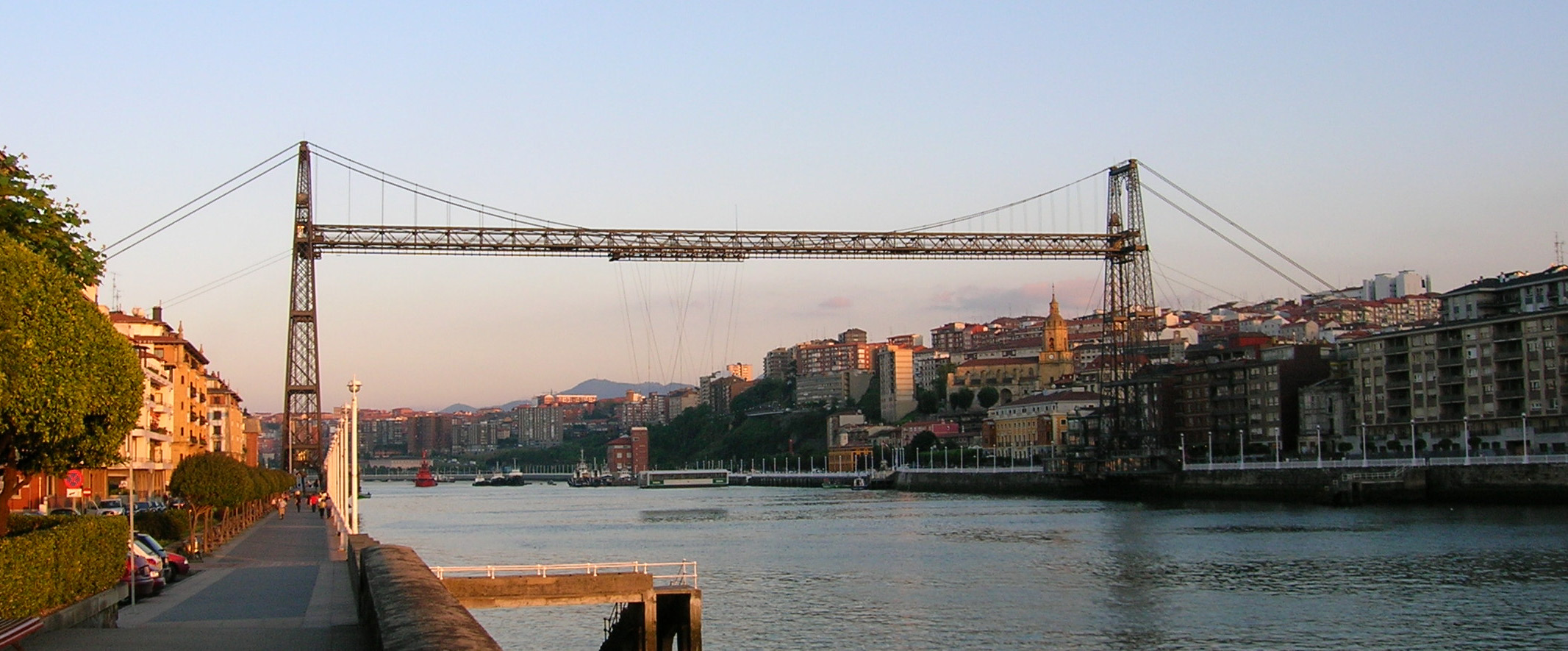
Insider tip: for about €11 (~$12) you can take a lift up and walk the high gangway across the top for estuary views — open roughly 10am to sunset and closed in high winds. Take Metro Line 1 to Areeta (Getxo side) or Line 2 to Portugalete; either way it's about 15 minutes from the centre.
7. San Mamés and Athletic Club — football the Basque way
Even if you don't follow football, San Mamés explains something about the Basque Country. The 53,000-seat stadium rebuilt in 2013 — nicknamed "La Catedral" — is home to Athletic Club, the only major European club that fields exclusively Basque players, a policy they've held for over a century and still win with. The exterior's ETFE panels glow at dusk. The "San Mamés Experience" stadium tour runs around €14–16 and takes you pitchside, through the dressing rooms and the trophy room.

Insider tip: if a match falls during your trip, buy a ticket — the atmosphere, with the whole stand singing in Basque, is worth more than most museums. The stadium sits right at Termibus (the San Mamés metro stop), which is also where the buses to San Sebastián leave, so you can combine it with a day trip.
Two more that don't need a full detour because they're already on your route: Azkuna Zentroa (the old Alhóndiga), a 1909 wine warehouse that Philippe Starck reimagined in 2010 around 43 wildly individual columns and a glass-bottomed rooftop pool — free to wander the atrium — and the newly reopened Museo de Bellas Artes, whose collection runs from El Greco and Goya to Gauguin and Basque modernists (€12 adult, free Tuesdays 10am–6pm for the permanent collection).
🗓️ How to Spend Three Days in Bilbao
Day 1: The Guggenheim, the river and the old town
Start at the Guggenheim at 10am (€12) before the crowds, allowing two to three hours including Serra's steel maze. Walk out and follow the river east along Abandoibarra, over the Zubizuri, pausing for the Isozaki towers and the red arch of La Salve. Cross into the Casco Viejo for a pintxo lunch around Plaza Nueva (budget €12–18 for three or four pintxos and drinks). Spend the afternoon on the Mercado de la Ribera and the Siete Calles, then ride the Artxanda funicular (€6 return) up for sunset. Dinner is a second, longer pintxo crawl — try Calle del Perro. Rough day cost excluding hotel: €45–70.
Day 2: Art, architecture and the Ensanche
Begin at the Museo de Bellas Artes (€12, or free Tuesday mornings) — give the new Foster wing an hour on its own. Walk through Parque de Doña Casilda to Azkuna Zentroa for a coffee under Starck's columns. Lunch on Calle Ledesma in the Ensanche, the locals' pintxo street away from the tourist crush. In the afternoon, tour San Mamés (€14–16) or shop and people-watch along the Gran Vía. For dinner, book a table — Mina across the river or Nerua inside the Guggenheim if you want a Michelin star, or a sit-down asador for a shared txuleta (aged beef chop) if you don't. Rough day cost excluding hotel: €40–120 depending on dinner.
Day 3: The coast — Vizcaya Bridge, Getxo and beyond
Take Metro Line 1 to the coast (about 15–25 minutes). Cross the Vizcaya Bridge gondola (€0.55) between Portugalete and Getxo, walk the walkway up top (€11) if you like heights, then stroll Getxo's belle-époque mansion promenade to the Punta Begoña galleries and a beach lunch. With more time, swap this for a bus to San Sebastián (PESA bus from Termibus, about €12, 1h10) or the clifftop hermitage of San Juan de Gaztelugatxe, 241 stone steps above the sea. Back in Bilbao, finish with a farewell poteo in the old town. Rough day cost excluding hotel: €25–55.
🧠 Essential Tips for Visiting Bilbao
When is the best time to visit Bilbao?
Bilbao has a green, Atlantic climate — which is a polite way of saying it rains, often, all year. November to January are the wettest months; July is statistically the driest, and August the warmest at around 24°C. The sweet spot is late May to June and September: mild temperatures in the low 20s°C, fewer crowds, and lower hotel prices than high summer. If you come in August, you'll hit Aste Nagusia (Semana Grande), the city's nine-day blowout — in 2026 it runs 22–30 August, with a rocket launched from the Teatro Arriaga balcony to open it, the plump festival mascot Marijaia presiding, nightly international fireworks fired over the estuary, and txosna party tents at El Arenal. It's a brilliant, chaotic time to be here — and a terrible one to expect a cheap, quiet hotel. Whenever you come, pack a light rain jacket; locals treat an umbrella as optional and a txapela (beret) as traditional.
How do you get around Bilbao?
Buy a Barik card first (€3 for the card plus a €5 minimum load). It's a shared, rechargeable card that cuts the fare on the metro, the EuskoTran tram, Bizkaibus, Bilbobus and even the Artxanda funicular, and several people can travel on one card. The Metro Bilbao — Lines 1 and 2, with Norman Foster's glass "fosterito" entrances — is clean, fast and runs roughly 6am to 11pm, to 2am on Fridays and all night on Saturdays. From the airport (Loiu), the Bizkaibus A3247 runs to Plaza Moyúa and the Intermodal every 15–30 minutes for €1.50 on Barik (€4.50 cash); a taxi is a flat €20–30. Honestly, though, the centre is so compact you'll walk most of it. For taxis, locals use the Bolt and Free Now apps.
Is Bilbao safe for tourists?
Very. Bilbao is one of Spain's safest cities and violent crime against visitors is rare, with no tourist areas you need to avoid. The realistic risk is pickpocketing in the tight, crowded pintxo bars around Plaza Nueva and the Casco Viejo, on a packed metro, and especially during Aste Nagusia, when the El Arenal crowds are prime hunting ground — keep your phone and wallet in a front pocket. The other hazard is underfoot: the Zubizuri's glass deck and the old town's worn cobbles get slick in the rain. There's no significant scam culture here beyond the resale-ticket fraud the Guggenheim warns about, so buy museum tickets from official sites only.
What should you eat in Bilbao?
Bilbao calls its bar snacks pintxos, not tapas, and they're a cuisine, not an afterthought. Start with the classics: bacalao al pil-pil (salt cod in an emulsified garlic-and-oil sauce that's harder to make than it looks), bacalao a la vizcaína in red pepper sauce, a Gilda, and txipirones (baby squid). Sit down at least once for a shared txuleta, the thick aged-beef chop that's a Basque religion, and if you can spare a day, the legendary grill Asador Etxebarri is about an hour away in Axpe. Drink txakoli, the bone-dry, faintly fizzy local white poured from a height to aerate it, or a Rioja Alavesa red from just south. Bilbao also has serious fine dining — Nerua, Mina, Etxanobe and Zortziko all hold Michelin recognition — if you want to bookend the bar crawls with something white-tablecloth.
🏨 Where to Stay in Bilbao
Bilbao is small enough that neighbourhood matters less than in most cities, but the Casco Viejo puts you in the pintxo action, while Abando and the Ensanche (around Gran Vía and Plaza Moyúa) are central, elegant and a short walk from everything, including the Guggenheim.
Budget (€30–90 / ~$32–97 a night): The Casco Viejo and Abando are full of pensiones and hostels. Quartier Bilbao Hostel and Latroupe La Granja offer dorm beds and private rooms near the old town; simple Casual-style hotels sit around €70–100. Book early for anything under €60 in summer.
Mid-range (€120–170 / ~$130–184 a night): This is Bilbao's sweet spot. Hotel Abando sits right by Gran Vía and the station; Hotel Conde Duque Bilbao faces the river by the Zubizuri; the riverfront Barceló Bilbao Nervión and the NH Collection Villa de Bilbao on Gran Vía are reliable four-stars within walking distance of the museums.
Luxury (€200–400+ / ~$216–432 a night): The Gran Hotel Domine Bilbao stares straight at the Guggenheim across the street, with a Javier Mariscal-designed interior and a rooftop terrace aimed at the titanium; the Hotel Carlton on Plaza Moyúa is the grande dame, a belle-époque landmark that has hosted everyone from Einstein to Hemingway; the boutique Hotel Miró sits neatly between the two big museums.
❤️ Beyond the Tourist Trail
Cross the river to Bilbao La Vieja, San Francisco and Zabala — "Bilbi" to locals — the old working-class quarter that's become the city's most interesting neighbourhood, full of multicultural food, street art and the kind of bars that don't make it into guidebooks. It's where you'll find Michelin-starred Mina sharing streets with Senegalese and Moroccan grocers. For a dated-but-worth-timing event, the Bilbao BBK Live festival takes over Mount Kobetas in early-to-mid July, and the Semana Grande fireworks competition (22–30 August 2026) is genuinely one of the best free shows in Europe if you grab a spot on the Arenal.
For a local ritual rather than a sight, do the txikiteo on Calle Ledesma in the Ensanche on a Thursday or Friday evening — it's where Bilbaínos crawl pintxo bars after work, with none of the old-town markup. And if the weather turns (it will), the Azkuna Zentroa atrium is a free, dry, genuinely strange place to pass an hour under Starck's 43 mismatched columns.
❓ Bilbao FAQ
How many days do you need in Bilbao?
Three days is ideal. Two days cover Bilbao's core — the Guggenheim, the Casco Viejo pintxo bars, the Fine Arts Museum, Artxanda and the riverfront — and a third frees you for the coast at the Vizcaya Bridge and Getxo, or a day trip to San Sebastián (about €12 and 1h10 each way by bus). If you only have 48 hours, you can still see the city properly; Bilbao is compact and walkable.
When is the best time to visit Bilbao?
Late May to June and September are best: temperatures in the low 20s°C, less rain, and smaller crowds than August. July is the driest month and August the warmest (around 24°C) but also the busiest, thanks to the Aste Nagusia festival, which runs 22–30 August in 2026. Bilbao rains year-round, so pack a light rain jacket whenever you go.
Do you need to book Guggenheim tickets in advance?
Yes, if you want to skip the line. Adult admission is €12 (students and over-65s €6, under-18s free), and a combined ticket with the newly reopened Museo de Bellas Artes is €16. Buy from the museum's official website only — it openly warns about resale fraud — and aim for the 10am opening on a weekday to beat the tour groups. It's closed most Mondays.
How do you get from Bilbao Airport to the city centre?
The Bizkaibus A3247 runs from the airport to Plaza Moyúa and Gran Vía in about 25 minutes, every 15–30 minutes, for €1.50 with a Barik card or €4.50 cash. A taxi takes 15–20 minutes and costs a fixed €20–30. There is no metro or train directly from the airport.
Is Bilbao a walkable city?
Yes — it's one of the most walkable cities in Spain. You can cross the centre on foot in about 20 minutes, and the 3-kilometre Abandoibarra riverside promenade links the Guggenheim, the Fine Arts Museum and San Mamés. For longer hops, the Barik card (€3 plus a €5 top-up) covers the metro, tram, buses and the Artxanda funicular at a discount.
What food is Bilbao famous for?
Pintxos — Basque bar snacks eaten standing, one at a time, with a small drink — are the headline, especially around Plaza Nueva and on Calle Ledesma. Signature dishes include bacalao al pil-pil (salt cod in garlic-oil emulsion), the Gilda skewer, and a shared txuleta (aged beef chop). Drink txakoli, the dry, lightly sparkling Basque white poured from a height.
Is the Vizcaya Bridge worth visiting?
Yes. The Vizcaya Bridge (Puente Colgante) is a UNESCO World Heritage Site and the world's first transporter bridge, built in 1893. Crossing the Nervión in its hanging gondola costs about €0.55, and walking the high gangway 45 metres up costs about €11. It's roughly 15 minutes from central Bilbao on Metro Line 1 or 2.
What's new in Bilbao for 2026?
The Museo de Bellas Artes reopened on 6 October 2026 after a near-four-year renovation and roughly 6,000-square-metre expansion led by Norman Foster, adding a glass volume called "Agravitas" over the existing building. Its collection — El Greco, Goya, Zurbarán, Gauguin and Basque artists — now sits two riverside blocks from the Guggenheim, giving Bilbao a genuine two-museum art core for the first time.
🐻 Plan your Bilbao trip with VoyaBear
Bilbao packs a lot into a small, rainy, delicious footprint — and the difference between a good trip and a great one is timing the Guggenheim right, hitting the correct pintxo bars, and knowing when the funicular catches the sunset. That's exactly what VoyaBear is built for: tell us how many days you have, what you want to eat, and how hard you want to walk, and we'll build you a personalised Bilbao itinerary with the bookings, timings and backup rainy-day plans already sorted. Start planning your Bilbao trip with VoyaBear and spend your time eating pintxos, not refreshing tab after tab. Download the VoyaBear app to carry the whole plan — maps, tickets and all — in your pocket.
Want this as an actual itinerary?
VoyaBear turns a guide like this into a day-by-day plan built around how you travel.
Plan my trip free