Bologna 2026: The Ultimate Food & Travel Guide
21 November 2026 · 21 min read

Bologna is the Italian city that food-obsessed travellers whisper about so the crowds keep heading to Florence instead. It is the capital of Emilia-Romagna, the region that gave the world Parmigiano Reggiano, balsamic vinegar, prosciutto di Parma and mortadella, and it wears three nicknames earned over nine centuries: La Dotta (the learned, for a university founded in 1088, the oldest in the Western world still running), La Grassa (the fat, for obvious reasons) and La Rossa (the red, for its terracotta rooftops and left-wing politics). You walk almost the entire historic centre under porticoes, roughly 62 kilometres of covered arcade that became a UNESCO World Heritage Site in 2021, which means Bologna is the rare Italian city where rain barely interrupts a day of sightseeing.
Come for the ragù, stay for the fact that a world-class medieval city still functions as a real working town of students, market traders and cyclists rather than a theme park. Here is exactly how to do it.
💡 Quick Answer: Bologna at a Glance
The short version for anyone planning fast:
- How many days do you need? Two full days covers the centre comfortably; three lets you climb a tower, walk to San Luca and eat properly.
- Best time to visit? April to May and September to October: mild weather, the university in session, no August shutdown.
- What to book ahead? Not much, but reserve the Clock Tower climb (€10 / about $11) and any sit-down dinner at a well-known osteria on a weekend.
- Airport to centre? The Marconi Express monorail runs BLQ to Bologna Centrale in 7 minutes for €12.80 (about $14) one way.
- Getting around? Walk. The centre is compact and almost entirely covered by porticoes; a single TPER bus ticket is €1.50 (about $1.65) if you need it.
- Rough daily budget? Around €90-130 (about $100-140) per person for a mid-range trip: a three-star room, two restaurant meals and a couple of sights.
- Can you climb the famous Asinelli Tower? No, not right now. It has been closed since 2023 while engineers secure its leaning neighbour, the Garisenda. Climb the Clock Tower instead.
- Top safety note? Bologna is safe; just watch for pickpockets around Bologna Centrale station and the crowded Via dell'Indipendenza.
🏙️ The Best Things to Do in Bologna
1. Piazza Maggiore, the Basilica di San Petronio and the Neptune Fountain
The main square is the obvious starting point, and the Basilica di San Petronio on its south side is the detail people miss until they are standing in front of it: the facade is only half-finished, marble and sculpture across the bottom third, bare brown brick above. Begun in 1390, it was planned to be larger than St Peter's in Rome until the Church reportedly diverted funds to stop it, and it was never completed. It is still one of the largest brick churches in the world, around 132 metres long. Entry is free.

Inside, look for the brass line set into the floor of the left aisle: the Meridian Line laid by astronomer Gian Domenico Cassini in 1655, about 67 metres long and still one of the longest indoor sundials anywhere. A beam of sunlight through a hole in the vault crosses it at solar noon. Insider tip: go up to the panoramic terrace (a small ticket, around €5 / $5.50, by lift) for a close view down onto the square and the rooftops; it is far less effort than any staircase. Just outside, in the adjoining Piazza del Nettuno, stands Giambologna's muscular bronze Neptune Fountain from 1566, which locals call simply "il Gigante", the giant.
2. The Two Towers (Due Torri)
Bologna once bristled with well over 100 medieval towers; around 20 survive, and the two that lean out of Piazza di Porta Ravegnana are the city's symbol. The Asinelli rises 97.2 metres with 498 steps inside, making it the tallest leaning medieval tower in Italy. Beside it the stumpy Garisenda tilts so alarmingly that Dante name-checked it in the Inferno.

Important for 2026: you cannot currently climb the Asinelli. It was closed in 2023 after the Garisenda was judged at risk of collapse, and a major project to secure the leaning tower has kept the area fenced and the climb suspended with no confirmed reopening date. Check the official Bologna Welcome site before you build a day around it. When it does reopen, booking is compulsory and the full ticket is around €5 (about $5.50). For now, admire them from below with an espresso and read on, because there is a tower you can climb.
3. The Clock Tower (Torre dell'Orologio) at Palazzo d'Accursio
With the Asinelli shut, this is the climb to make. The Clock Tower rises from Palazzo d'Accursio, the old town hall on the west side of Piazza Maggiore, and the ticket (€10, reduced €7, roughly $11 / $7.70) includes an audio guide and entry to the Municipal Art Collections inside the palazzo.

The reward is a 360-degree panorama from the terrace: the sea of red roofs that earns Bologna its nickname, the Two Towers at eye level and the San Luca sanctuary floating on its hill to the south-west. Insider tip: there is no lift and the final stretch is a genuinely narrow staircase, so skip it if tight spaces bother you. Aim for a late-afternoon slot in good weather; the low sun turns the whole city copper and the terrace is small, so morning tour groups clear out by then.
4. The Archiginnasio and its Anatomical Theatre
A two-minute walk from Piazza Maggiore, behind San Petronio on Piazza Galvani, sits the first permanent home of the University of Bologna, built in 1563. The courtyard and double-tiered loggia are free to wander and are plastered with roughly 6,000 carved and painted coats of arms left by centuries of students, one of the densest displays of heraldry in Europe.
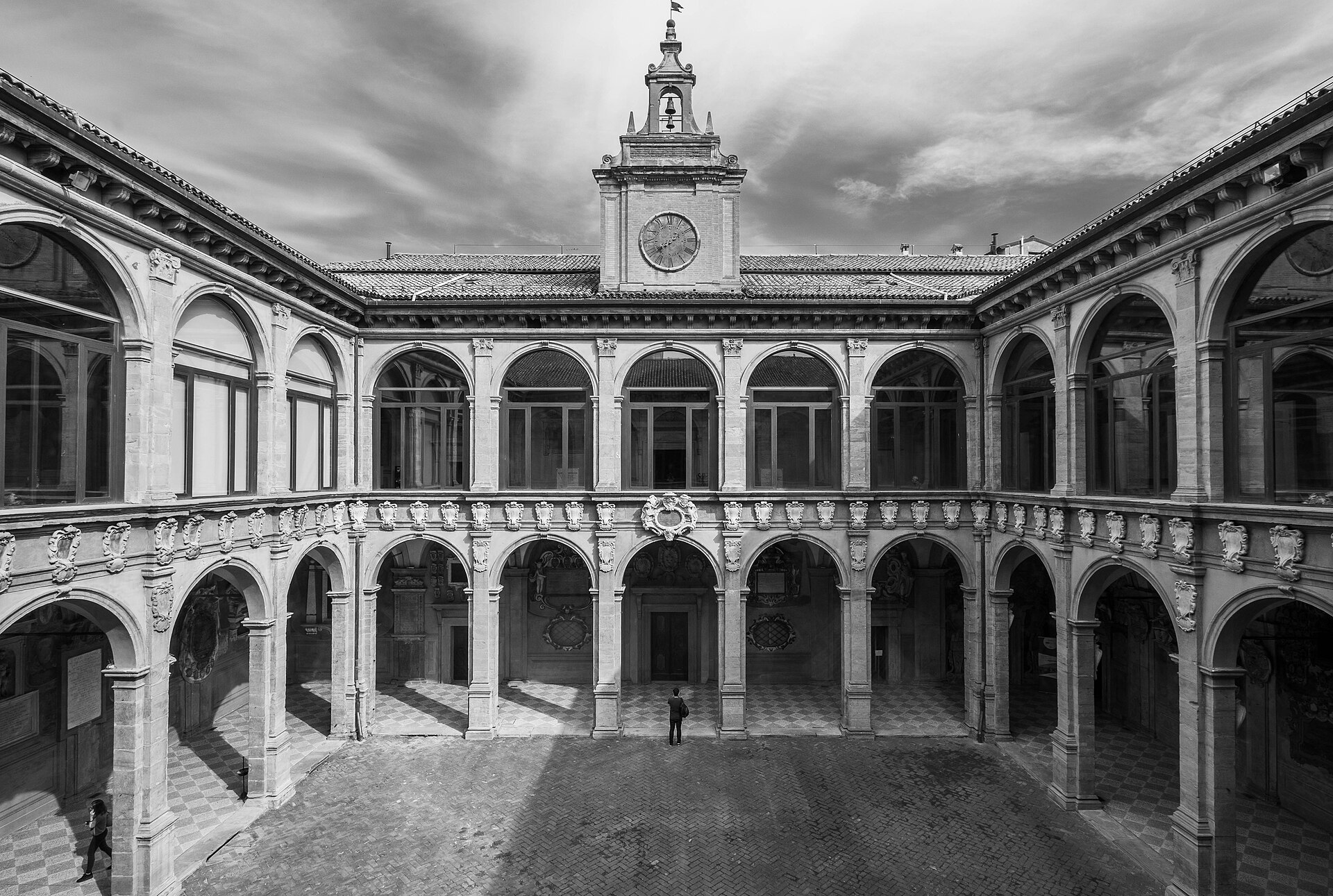
The paid highlight (a small ticket, around €3 / $3.30) is the Teatro Anatomico, a 1637 lecture theatre carved entirely from spruce, where public dissections were once performed under a canopy held up by two skinless wooden figures known as the spellati. It was rebuilt after a 1944 bomb destroyed it, using the salvaged original fragments. Insider tip: it shares the building with a working historic library, so keep your voice down; opening is roughly Monday to Saturday, and it closes earlier than most sights, so go in the morning.
5. The Basilica di Santo Stefano (the Seven Churches)
Down the handsome Via Santo Stefano, which widens into a triangular piazza lined with porticoed palazzi, is the city's most atmospheric religious site: a complex of interlocking churches, chapels and courtyards known as the Sette Chiese, the Seven Churches. Entry is free, though a donation is expected.

Wander through the octagonal Church of the Holy Sepulchre, built to evoke Jerusalem, into the Courtyard of Pilate with its stone basin donated by the Lombard kings Liutprand and Hildeprand in the 8th century, and out to the quiet Benedictine cloister. Insider tip: it closes for a long midday break (roughly 12:30 to 2:30) and part of Monday, so time your visit for mid-morning or late afternoon. On the piazza outside, the Saturday-Sunday antiques market is one of the better ones in the city.
6. The Quadrilatero and the covered markets
Immediately east of Piazza Maggiore, a grid of narrow medieval lanes called the Quadrilatero has been Bologna's food market since the Middle Ages, and the street names still describe the trades: Via Pescherie Vecchie (old fishmongers), Via Drapperie (drapers). Today the stalls and tiny shops overflow with mortadella, tortellini, parmesan wheels and crates of produce.

Stop at Salumeria Simoni (Via Pescherie Vecchie 3/b) for a tray of salame rosa and mortadella, then push on to the Mercato delle Erbe (Via Ugo Bassi 25), a covered market hall where stalls at the back double as cheap lunch counters. Insider tip: the Quadrilatero turns into an aperitivo crush from about 6pm as students spill out with plastic cups of Pignoletto; come at 10am instead if you want to actually see the produce and talk to the traders.
7. The Portico di San Luca and the Sanctuary
Bologna's porticoes are the UNESCO headline act, and the most spectacular single stretch runs from the Porta Saragozza gate up to the hilltop Sanctuary of the Madonna di San Luca. At roughly 3.8 kilometres and 666 arches, it is the longest continuous portico in the world, built in the 18th century so a revered icon of the Madonna could be carried up to the city each year without getting rained on.

From the Meloncello arch at the halfway point the covered walkway climbs steadily uphill; budget about 45 minutes to an hour of steady walking from Porta Saragozza, and wear real shoes because the final stretch is a workout. The payoff at the top is the baroque basilica and a sweeping view back over the city and the Apennine foothills. Insider tip: if you would rather not walk up, the tourist "San Luca Express" road train runs from Piazza Maggiore, or take city bus 20 to the Meloncello and climb only the steepest, prettiest final section.
🗓️ How to Spend Three Days in Bologna
Day 1: The historic core
Start in Piazza Maggiore (free) with a coffee, then go into San Petronio to find Cassini's meridian line (free; terrace about €5). Walk two minutes to the Archiginnasio and its Anatomical Theatre (about €3), then lose an hour in the Quadrilatero market lanes, grabbing a mortadella panino from a salumeria for lunch (€5-7 / about $6-8). In the afternoon climb the Clock Tower for the rooftop panorama (€10). End at the Two Towers, five minutes away, then settle in for an early dinner of tagliatelle al ragù (€10-13 / about $11-14). Total sightseeing spend: roughly €18 (about $20), walking time between stops under 10 minutes each.
Day 2: Churches, art and the university quarter
Begin at the Basilica di Santo Stefano (free) when it opens at 9:30 to have the Seven Churches nearly to yourself. Stroll the porticoed Via Santo Stefano, then cut north into the university quarter around Via Zamboni, home to the oldest university in the Western world and its cheap, lively bars. Visit the Pinacoteca Nazionale (Via delle Belle Arti 56; a modest entry fee) for Emilian masters like Guido Reni and the Carracci. Lunch at the no-bookings institution Osteria dell'Orsa (Via Mentana 1), where a plate of tagliatelle runs about €8 (roughly $9) at communal tables; arrive at noon to beat the queue. Spend the afternoon simply walking under porticoes, then do aperitivo in the Quadrilatero.
Day 3: Up to San Luca and a food town nearby
Dedicate the morning to the Portico di San Luca: walk the 666 arches up to the sanctuary, or ride the San Luca Express part way and climb the rest, then come down for a late lunch. With the afternoon free and Bologna Centrale being one of Italy's great rail hubs, take a quick day trip: Modena is about 30 minutes by train (home of balsamic vinegar and Osteria Francescana), Ferrara about 30 minutes, Parma under an hour, and Florence just 37 minutes on a high-speed Frecciarossa. A regional ticket to Modena is around €5 (about $5.50); the Florence high-speed train is usually €15-30 (about $16-33) if booked ahead.
🧠 Essential Tips for Visiting Bologna
When is the best time to visit Bologna?
April to May and September to October are the sweet spots: daytime temperatures around 18-24°C, the university in full term so the city feels alive, and none of the summer shutdown. July and August are hot and humid, often above 30°C, and because many Bolognesi leave for the coast, a number of the best family-run trattorias simply close for part of August, so check before you count on a particular place. Winter is cold, grey and frequently blanketed in the thick Po Valley fog (nebbia), which is genuinely atmospheric under the porticoes, and December brings Christmas markets to Piazza Maggiore and a festive buzz to the covered lanes.
How do you get around Bologna?
You walk. The historic centre is small, flat and almost entirely porticoed, so an umbrella is rarely necessary. For the airport, the Marconi Express monorail connects BLQ to Bologna Centrale in 7 minutes and runs frequently from early morning to around midnight; a single is €12.80 and a return €23.30 (about $14 / $25). City buses are run by TPER: a single ticket is €1.50 bought in advance (via the Roger or TPER app, or a tabaccheria) or €2 on board, valid 75 minutes. There is no metro. Note that much of the centre is a restricted traffic zone (ZTL) monitored by cameras, so do not drive in; if you arrive by car, park outside the ring road and walk.
Is Bologna safe for tourists?
Yes. Bologna is a prosperous university city and violent crime against visitors is rare. The real risk is pickpocketing, concentrated in exactly the predictable places: the concourse and platforms of Bologna Centrale station, the busy shopping artery Via dell'Indipendenza, and the Quadrilatero and markets when they are shoulder-to-shoulder at aperitivo hour. Keep your phone and wallet in a front pocket or zipped bag in those spots. The university area around Via Zamboni and the Piazza Verdi gets rowdy and litter-strewn late at night but is not dangerous. Cyclists move fast under and alongside the porticoes, so look before you step out.
What should you eat in Bologna?
First rule: there is no "spaghetti bolognese" here, and asking for it marks you instantly as a tourist. The local ragù is served on fresh egg tagliatelle, never spaghetti. Build your eating around these: tagliatelle al ragù (the real thing, a slow-cooked meat sauce with no garlic or herbs); tortellini in brodo, tiny hand-folded pasta stuffed with pork, mortadella and parmesan in a clear meat broth, the classic Sunday dish; lasagne verdi alla bolognese, made with spinach pasta; and mortadella, the silky, pistachio-flecked pork sausage that Bologna invented (and that "baloney" is a corruption of). For addresses: Osteria dell'Orsa (Via Mentana 1) for cheap, lively plates of pasta; Osteria Bottega (Via Santa Caterina 51) for a more serious, booking-only ragù; and the historic Osteria del Sole (Vicolo Ranocchi 1/d), open since 1465, where you bring your own food and buy only the wine. Drink local: sparkling white Pignoletto, fizzy red Lambrusco and Sangiovese from the hills.
🏨 Where to Stay in Bologna
Bologna is compact enough that anywhere inside the ring of old gates is walkable, but each pocket has a character.
Budget (around €35-75 / $38-82 a night): The streets around Bologna Centrale and the northern end of Via dell'Indipendenza have the best-value B&Bs, guesthouses and a few hostels like the well-run Combo or Dopa Hostel, and you are a flat 15-minute walk or one bus stop from Piazza Maggiore. It is less pretty but practical, especially if you are day-tripping by train.
Mid-range (around €90-180 / $100-195 a night): Base yourself in the Centro Storico proper, within a few minutes of Piazza Maggiore, for three- and four-star hotels and stylish apartments where you can walk home from dinner. The area around Via Santo Stefano is the sweet spot: central but quieter and more elegant than the student-heavy Via Zamboni quarter, which is cheaper but noisier at night.
Luxury (around €250-450+ / $270-490+ a night): The grande dame is the Grand Hotel Majestic "già Baglioni", a frescoed five-star steps from the cathedral and the only true luxury hotel in the historic core. I Portici Hotel, built around a 19th-century concert hall, and a handful of design boutiques fill out the top end. Book these well ahead during trade-fair weeks, when the whole city sells out.
🎭 Beyond the Tourist Trail
Most day-trippers never leave the triangle between Piazza Maggiore and the Two Towers, which means the rest of the city is refreshingly yours. The former Jewish ghetto, a knot of tiny lanes just north-east of the towers around Via dell'Inferno, is one of the oldest in Italy and almost silent even in high season. For a genuinely local experience, seek out Bologna's "Little Venice": a window on Via Piella (the Finestrella di Via Piella) opens onto a hidden canal, a surviving fragment of the medieval waterway network that once powered the city's silk mills and is now mostly bricked over.
For emerging energy, head to the Bolognina district across the railway tracks north of the station, a formerly working-class, increasingly multicultural quarter where you will find some of the city's most interesting new restaurants, bakeries and bars at non-tourist prices, plus the MAMbo contemporary art museum in the old bread factory on Via Don Minzoni. And if you are here in late June or early July, the Cineteca di Bologna runs Il Cinema Ritrovato, projecting restored classic films onto a giant screen in Piazza Maggiore after dark to a packed, free-to-attend crowd. It is one of the great European summer nights out, and almost no tourist plans around it.
❓ Bologna FAQ
How many days do you need in Bologna?
Two full days is enough to see the historic centre without rushing. A third day lets you walk the San Luca portico, slow down for the food, or take a train to Modena, Ferrara or Florence, all of which are under an hour from Bologna Centrale.
When is the best time to visit Bologna?
April-May and September-October, for mild 18-24°C weather, a city full of students rather than shut for the holidays, and none of the summer humidity. Avoid August, when the heat peaks and many trattorias close.
Can you climb the Asinelli Tower in 2026?
No. The Asinelli (97.2 metres, 498 steps) has been closed since 2023 while engineers secure the adjacent leaning Garisenda tower, with no confirmed reopening date. Climb the Clock Tower (Torre dell'Orologio) at Palazzo d'Accursio instead, which costs €10 and gives you a 360-degree rooftop panorama.
How do you get from Bologna Airport to the city centre?
Take the Marconi Express monorail, which links Bologna Marconi Airport (BLQ) to Bologna Centrale station in 7 minutes. A one-way ticket is €12.80 and a return is €23.30. From Centrale the centre is a short walk, bus or taxi.
Is Bologna worth visiting, or should you just go to Florence?
Bologna is worth a stop in its own right and is 37 minutes from Florence by high-speed train, so you do not have to choose. It offers Italy's best-regarded regional cuisine, the world's oldest university, 62 kilometres of UNESCO porticoes and a fraction of Florence's crowds.
What food is Bologna famous for?
Fresh egg pasta above all: tagliatelle al ragù (never "spaghetti bolognese", which is not a local dish), tortellini in brodo and lasagne verdi, plus mortadella, the pistachio-studded pork sausage the city invented. Wash it down with local Pignoletto, Lambrusco or Sangiovese.
Do you need a car in Bologna?
No. The historic centre is compact, flat and almost entirely covered by porticoes, so it is best explored on foot, and the centre is a camera-enforced restricted-traffic zone (ZTL) you should not drive into. For day trips, fast, cheap trains from Bologna Centrale beat driving.
Where is the best area to stay in Bologna?
For first-time visitors, the Centro Storico around Piazza Maggiore and Via Santo Stefano puts you within walking distance of everything. Budget travellers get better value near Bologna Centrale station, a 15-minute walk north, which is also handiest for day trips.
❤️ Let VoyaBear Plan Your Bologna Trip
This guide gives you the bones of a great few days, but the best Bologna trip is the one shaped around how you travel: whether you want to spend three hours in one trattoria or sprint between towers, whether you are walking the full San Luca portico or riding to the Meloncello, whether you have a weekend or a week stitched together with day trips to Modena and Florence. VoyaBear builds personalised, day-by-day itineraries that account for your pace, your budget and your appetite, with real opening hours, walking times and restaurant picks already slotted in, so you are not rebuilding this plan from scratch at a café table. Tell VoyaBear what you love, and let it map your Bologna. Start planning at voyabear.com.
Want this as an actual itinerary?
VoyaBear turns a guide like this into a day-by-day plan built around how you travel.
Plan my trip free